- IMEC is alive: India–Turkey tensions shape IMEC route via Oman
Jordan, Israel and Greece.
Three new political-economic axes have been converging in recent weeks — none of which include Turkey:
A renewed Qatar–Saudi axis, including the announcement of the Doha–Riyadh high-speed rail line and economic agreements between Saudi Arabia and Syria.
The Oman–India–Jordan axis, forming the eastern and western anchors of IMEC trade routes. The Israel–Cyprus–Greece axis, connecting IMEC from the Middle East to Europe via the Mediterranean. - How Solar Saved Pakistan’s Economy (sort of):
- The battle for Aravalli range: Arnab's 5 stinging questions. Who really gains?
- Micro-plastics in your Zomato order: People who have five to 10 takeaways per month might be consuming excessive microplastic from the containers their meals come in. "Miicro- and nano- plastics, have been detected in virtually every organ in our bodies, including arteries, brain, blood, placenta and testicles".
- Leftists abandoning Muslim women? Who knew! "So many big names in progressive and feminist circles, would personally agree with us, but when it came to taking a public stand, they'd go back on their promise. Only Asghar Ali Engineer stuck publicly to the stand he took privately. And he bore the brunt for doing so".
- Putin-Bush talks: 'A Junta with nukes'-revelations on Putin-Bush talks disclose Putin's 'Pakistan' warning
- Why So Many Jews Fall In Love With Buddhism: A surprising number of American Buddhists are Jewish, enough to earn the nickname JewBus.
- Madhavi Latha: The Engineer behind the Chenab Railway Bridge, the world's highest, standing at 359 meters above the Chenab River.
Sunday, December 28, 2025
Quick notes: IMEC is alive | Microplastics...

Friday, December 19, 2025
Quick notes: State capitalism | Denaturalisation...
- CEOs are learning to live with Trump’s turn to state capitalism. Last week Nvidia finally got permission to sell one its most advanced semiconductor chips to China. The catch: The federal government will take 25% of the revenue from those sales.
The Nvidia deal says something important about the relationship between business and government under President Trump. His regular intrusions into the boardroom—taking equity stakes, revenue slices or a “golden share”; prodding companies to lower prices or sell drugs through a federal website—are a sort of state capitalism, in which the state doesn’t necessarily own companies, but uses its substantial leverage to steer their behavior. - Trump's biggest gift to CCP yet: Trump’s decision to let China have Nvidia chips is dangerous. . . China can accelerate science and engineering with the H200 better than any of the newer hardware from Nvidia.
-
Denaturalisation: Some naturalised Americans likely to lose citizenship
-
"De-Indianise" Call: "1 H-1B Worker Equals 10 Illegal Aliens". . . Brown MAGAs go into hiding.
-
Hit hard by Trump: Tata, Infosys and Cognizant to bear brunt of Trump’s $100,000 H-1B fee
- Worst fears coming true: China may have reverse engineered EUV lithography tool in covert lab, report claims — employees given fake IDs to avoid secret project being detected, prototypes expected in 2028
- India needs its own 'Singapore' (outside India): As global scrutiny grows, Chinese firms look to call Singapore home. "The Singapore brand is trusted worldwide. Singapore is valued for its international flavour, neutrality, and is culturally easy for Chinese firms and their expats to adapt to,"
- India's Nuclear Power Push: Big goals, slow build. Nuclear energy share in total installed capacity remains limited, fluctuating between 1.9 per cent and 2.9 per cent from FY10 to FY24.
- 'Thar Desert Will Reach Delhi Soon': Around 90 percent of the Aravalli hills is in the height of 30 to 80 metres. Now they are in danger of perishing. . . BikAss Gando Thayo Che
- 73 Ragas with Abby V:
- We don't want no AI: LG forced a Copilot web app onto its TVs but will let you delete it after user backlash.
- Education cut off from society: Unable to learn English, Andhra student dies by suicide.
- Cover up: The UK wants Apple and Google to install “Nudity-Blocking Software” on iPhones and Android phones
- Is Iran dying?: Who Can Solve Iran’s Many Problems? Not I, Says the President.
- The US reverse engineered the Iranian Shahed-136 drones! :
- Aravallis: With one legal stroke, over 90% of the Aravalli range was erased on paper, handing it over to mining mafias, real-estate sharks & profiteers.
The US Marine Corps is testing a Low-Cost Uncrewed Combat Attack System (LUCAS) as a long range suicide drone. The US reverse engineered the Iranian Shahed-136 drones!
— Kiran Kumar S (@KiranKS) December 12, 2025
Too bad for Iran. Not only lost against Israel, got the nuclear sites hit, but also lost drone tech. #TWZ pic.twitter.com/LntStsg8vG
#SaveTheAravallis | Over 1.8 billion years old, the Aravalli Hills form a natural barrier protecting North India from desertification and severe air pollution. A recent Supreme Court definition has altered how the range is identified, leaving nearly 90 per cent of the hills… pic.twitter.com/DYmPteIXCn
— Republic (@republic) December 20, 2025
The shameless Haryana govt passes the bill that will open the ecologically sensitive Aravallis to construction... NCR to lose more green cover... #SaveTheAravallis @I_Am_Gurgaon #AirPollution pic.twitter.com/YOAtG5E1ka
— Shruti Malhotra (@Shruti_Malhotra) February 28, 2019
#SaveTheAravallis | By redefining what a "hill" is, a legal technicality has stripped protection from India’s oldest shield against desertification. Tonight’s debate asks the question – is environmental integrity being sacrificed for mining and sprawl?
— Republic (@republic) December 18, 2025
Watch… pic.twitter.com/YFRRuYYZw5
Sunday, December 7, 2025
Quick notes: Peaceful rise | Deindustrializing Germany...
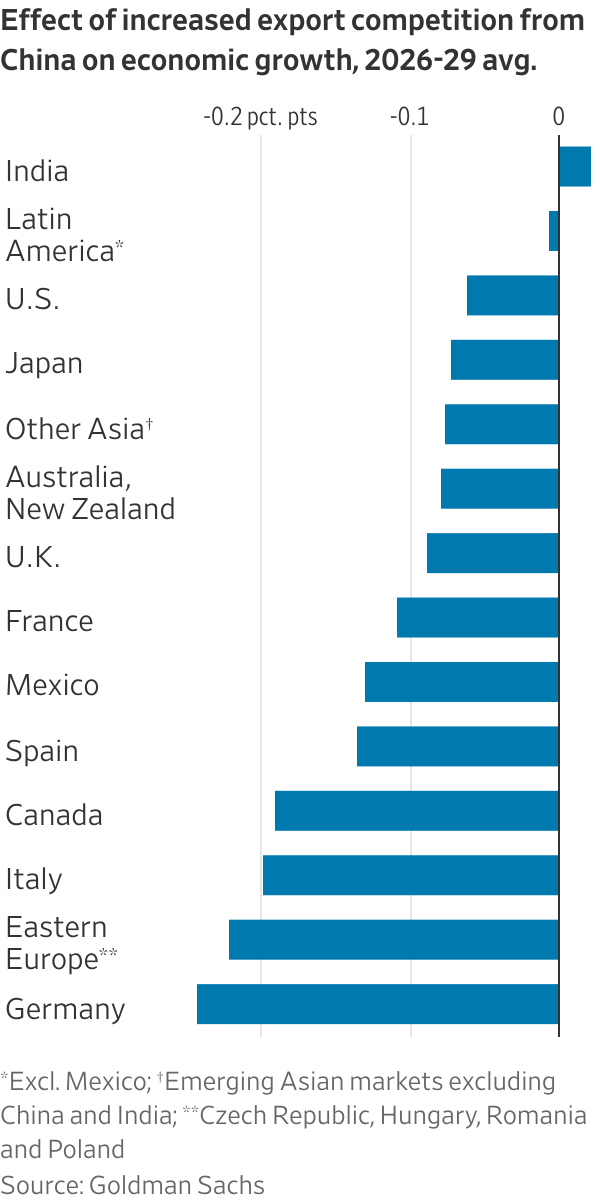
- China’s growth is coming at the rest of the world’s expense: “China is driven by a fortress mentality and sees industrial dominance as key to wealth and power”.
The most effective way to turn back China’s export onslaught would be for the U.S. to coordinate with like-minded partners. Trump has to date shown no interest in such a united front.
- Deindustrializing Germany: Germany’s industrial might was built on equilibrium cheap Russian energy, Chinese technology partnerships, and an export-driven alliance with global markets. That balance has been obliterated.
- Swami Vivekananda on China: ‘I see before me the body of an elephant. There is a foal within. But it is a lion-cub that comes out of it. It will grow in future, and China shall become great and powerful.’
- China Has a Different Vision for AI: "It Might Be Smarter."
Silicon Valley has spent mountains of money in pursuit of AI’s holy grail: AGI. Enthusiasts say it will give the U.S. insurmountable military advantages, help cure cancer and solve climate change, and eliminate the need for people to perform routine work such as accounting and customer service.
In China, by contrast, leader Xi Jinping has recently had little to say about AGI. Instead, he is pushing the country’s tech industry to be “strongly oriented toward applications”—building practical, low-cost tools that boost China’s efficiency and can be marketed easily. - KK Mohammed Slams BJP Govt: 'Dark Age for ASI', urges handover Of Gyanvapi, Mathura
Deindustrializing Germany: The Silent Coup of Brussels, Washington & the War Economy
— Navroop Singh (@TheNavroopSingh) October 22, 2025
Germany’s collapse is no longer a distant warning it is unfolding in real time on the factory floors of Wolfsburg. Volkswagen, the crown jewel of Europe’s manufacturing prowess, is preparing to…
Friday, December 5, 2025
Quick notes: Solar hack | Self-reliance...
- "We learnt a lot from the very first prototype in India": Placing solar panels over the 4,000 miles of California’s open canals could save up to 63 billion gallons of water annually — enough to meet the needs of 2 million people. we need an Indian name for this solar hack
-
India Builds Best When It Builds Alone:
Take missiles, for example. If you want a missile, you have to build it yourself; nobody will sell it to you.
This is also how ISRO succeeded -- you can't import a satellite launch vehicle.
In such segments, DRDO and ISRO come out looking very good.
Take for instance, the ring laser gyroscope developed by DRDO under the Integrated Guided Missile Programme.
Older missiles used mechanical gyroscopes; the new laser gyroscope is far more accurate.
Nobody would give that to us, so DRDO developed it indigenously.
However, in areas where an import option exists -- like fighter jets, main battle tanks, or towed artillery guns -- the moment DRDO gets close to a solution, someone shows up offering to sell it.
The sellers also have an interest in undermining DRDO.
There are also numerous critical subsystems developed that aren't as visible.
For example, the heat shield technology for re-entry vehicles was first mastered in DRDO for the Agni missile.
This is why the Americans were so opposed to Agni in the 1980s, unlike other missiles -- it was a re-entry vehicle.
We also had to master the technology of mounting printed circuit boards in these missiles that can withstand extreme shock, vibration, and temperature.
The US had a far better ecosystem for spinning off military technology for civilian use --Teflon came from the space programme.
DRDO could have done this, but it was stifled by financial and ideological hurdles.
For example, armour-penetrating explosives could have had mining and other civilian applications. Similarly the laser gyro, heat shield etc.
The commercialisation never took off because our finance people were scared to make decisions.
I don't necessarily blame them; they fear audit objections. The whole system is messed up.
This is also why government startup funds often go unspent -- no one wants to take the risk inherent in venture capitalism, where you expect many failures for one big success.
This culture of audit objections stifles innovation, and no government, including the present one, has shown the willingness to truly understand and fix this problem.
Our biggest success was the control law for the LCA.
It started around 1992. Girish Deodhare, who just retired as DG of ADA, was my PhD student at Waterloo and joined CAIR.
Dr Kota Harinarayana was the programme director of ADA.
Initially, Martin Marietta was supposed to design the control software. They would talk big but belittle Indian capabilities and refused to share design documents, only giving final numbers.
Dr Kalam, who took over as DG in July '92, called a meeting -- on a Sunday -- and appointed Prof Roddam Narasimha FRS, to head a committee to decide if we could build the control law indigenously. We all said we could.
These foreign companies weren't impressive technically and weren't offering a knowledge transfer.
We decided to go for a state-of-the-art digital fly-by-wire control with a 32-bit floating-point processor, which was advanced for the time.
Prof Narasimha recommended we do it ourselves, and Dr Kalam agreed. He appointed Professor I G Sharma of IISc as an independent assessor to report to the ADA governing council every three months.
We designed the first cut of the control law in about two years.
A major hurdle was computing power. Due to international restrictions, we couldn't get powerful computers in India.
We rented time on a British Aerospace flight simulator in the UK.
Our team would go there with the software on tapes, and our test pilots would fly the LCA control law on that simulator.
Interestingly, the BAE guys, who were also working on the Eurofighter, invited our pilots to try their simulator.
Our pilots later reported that they found the LCA's handling qualities to be better!
Professor M Vidyasagar, FRS, is a Distinguished Professor at IIT Hyderabad. He earned his BS, MS, and PhD in electrical engineering from the University of Wisconsin. - Blue skies are a luxury in India: It’s the same endless blue dome that stretches over America, Europe, and India alike. But it’s not blue anymore in most Indian cities. The saddest part? We got used to it.
- Royal Enfield - From a Joke to Global Domination:
Ram mandir needs trees and water bodies to be the model temple of the maryada purushothaman
— Prof राजीवः श्रीनिवासः (@RajeevSrinivasa) November 27, 2025
Trees have literally disappeared from the discourse of India today, especially in its urban and Dharmika landscape.
— Mahakaul (@i_mandhata) July 9, 2025
Why do we need to focus on it? Here is a short explainer on the importance of trees to our Dharmika ecosystem #tree #trees #hindu #dharma #landscape #urban pic.twitter.com/YWPhyoTuyw
I feel a tad bit sad every time I go outside the country. In Vietnam now. Lots of parks, used by the elderly for exercise and socializing. Lots of bicycles on the roads. We could have all this and more if only we could root out corruption and develop civic sense in India. https://t.co/Lb0rNBVSzf pic.twitter.com/ggQVOWAxYT
— Vishnu Sreekumar (@vishnusreekumar@masto.ai) (@vishnusreekr) October 24, 2025
Subscribe to:
Comments (Atom)